
 Data Analytics for the Project Manager
Are traditional metrics outdated? As project failures continue, the question is what are we doing wrong?
Have we skipped steps? Do we change our minds on what the project should be and call that agile? How can we meet business case objectives while still adapting to new information as the project evolves?


Project Failure Is Not an Option
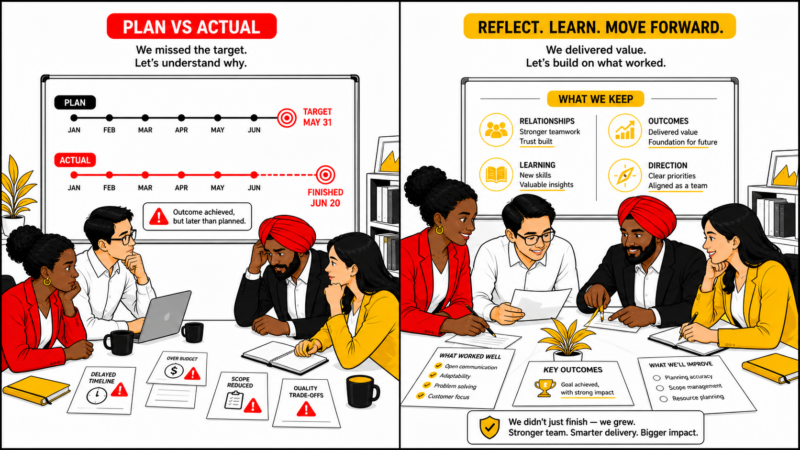
Dr. Frank Murphy’s central argument is not that projects never fail. It is that project teams need to think differently about failure, success, and what can still be salvaged when things go wrong. In his view, projects are fundamentally about relationships, and even when objectives are missed, teams can still produce results worth building on.
Failure and Stretch
Murphy says that if you are doing projects and never failing, you are probably not stretching.
He uses Apollo 13 as a framing idea: there were failures, but the mission still ended in a larger success because the crew got home. His point is that a project can miss targets, run late, exceed budget, or deliver something poor in quality, and still contain outcomes that matter.
He defines failure in familiar ways—missed objectives, wrong deliverables, lateness, budget problems, and poor quality—but keeps returning to one question: did anything good come out of it?
A Live Case
Murphy structures the session around a recent story from his Fortune 100 experience.
The project was a digital transformation effort in marketing technology, initially framed as moving data for evergreen marketing campaigns. What started as a seemingly simple data movement problem became more complex once marketing introduced new campaigns, leadership changed its mind about which campaigns mattered, and the team discovered that not all of the hundreds of data attributes were useful.
The project spanned multiple budget years, and the budget kept shrinking while leadership expected the same scope to be delivered. At the same time, architectural direction became fragmented.
Instead of one accountable architect, the work was split across multiple architectural roles, while fundamental alignment problems remained unresolved, including inconsistent tables across databases and no agreed design direction.
Where the Project Struggled
Murphy identifies several factors that repeatedly hurt the program. One was budget pressure without corresponding scope reduction. Another was architectural indecision, especially the inability to get one decision-maker who could unify the direction.
Executive sponsorship was also weak in practice because sponsors still had to go to another committee for major decisions, which meant the people closest to the project could not effectively defend what the program needed.
He also points to resource and skill-set problems, and to a recurring pattern of chasing “best in class” software rather than choosing tools that simply worked well with the broader suite.
For him, that created avoidable complexity.
Scale and Testing
One especially revealing problem was scale. The team tested in a limited sandbox with around 300 people, but marketing needed campaigns that could run against roughly 2 million recipients. The first campaign took eight hours to run, while marketing expected it to run in one hour. Murphy’s point is that the data moved, the process technically worked, and the return on investment was strong, but the performance gap still exposed a major problem in how expectations and scaling requirements had been handled.

Even here, though, he frames the outcome as mixed rather than purely negative: the team had moved the data, run a new type of campaign, and achieved good ROI. The fact that it took eight hours made it imperfect, but not worthless.
Failure Factors in Practice
Murphy refers to common failure causes such as lack of resources and lack of user involvement, but focuses more heavily on what he saw directly. Architectural direction, executive sponsorship, tool choices, business-unit changes, and planning methods all contributed to ongoing trouble.
He gives special attention to PI planning and the way innovation sprints reduced available development time while delivery expectations remained fixed. In his telling, the math never worked, yet the organization kept acting surprised when deadlines slipped.
Business-unit changes also kept moving the scope. Murphy responded by anchoring status reporting to the larger original goal—move the data—even as executives kept redefining the work underneath that umbrella. He says leaders disliked seeing their scope changes explicitly called out, but he viewed that as necessary accountability on a multi-year, multimillion-dollar program.
Watermelon Status
Murphy spends time on metrics and status reporting because he sees them as part of the honesty problem. He wanted clearer, more automated, data-based reporting that showed throughput and actual progress, but ran into resistance over what caution or red should mean.
Until a milestone was officially missed, some leaders did not want to acknowledge caution at all.
That is why he uses the image of a watermelon for status: green on the outside, red on the inside.

He describes trying to surface that tension more honestly, only to find that caution had already been ignored for months by the time leadership was willing to acknowledge deeper trouble.
Making Progress by Narrowing Scope
Murphy eventually found more traction by narrowing attention to the most valuable data and campaigns. Using a Pareto-style approach, the team focused on the smaller share of data attributes that drove most of the useful results. That let them make more progress than trying to move everything at once.
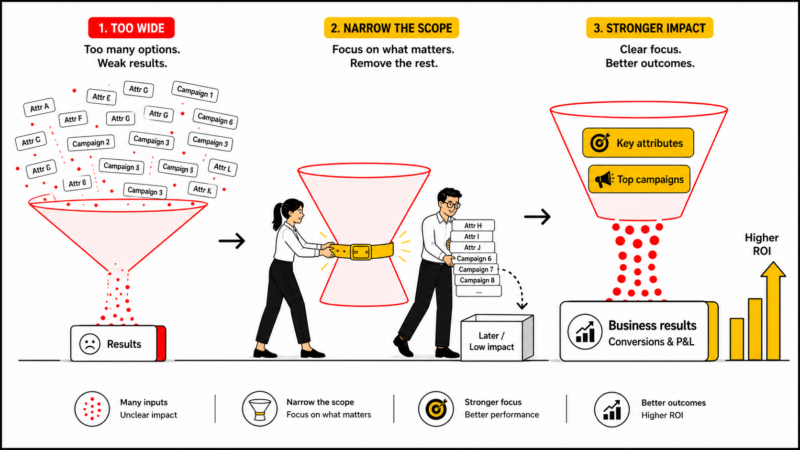
This helped the team connect the work more directly to the real business objective, which was not simply moving data or even running campaigns. The real goal was higher conversion and stronger profit and loss performance. Once that connection became clearer, the team could better defend why smaller funnels, fewer attributes, or fewer campaigns might still produce better results.
Relationships and Reporting
Murphy returns often to relationships. He says project management is “really all about relationships,” and that how a leader enters the room changes the project’s energy. He describes trying to build alliances with executives outside the sponsor role so they would support more honest reporting and help reinforce the numbers being shown.
Over time, that made it easier to present one-page visual reporting with links back to deeper documentation, though trust had to be built first.
He also emphasizes stakeholder involvement across business units. In his example, different business lines had different levels of profit contribution and different expectations about who should be prioritized.
Without stakeholder pressure in the right rooms, he argues, project and program managers would never be able to win those decisions on their own because executives would decide privately and come back with conclusions that the delivery teams had to absorb.
Risk, Accountability, and Team Protection
Murphy argues that project managers need to keep executives aware of risks in a way they can actually use. He favors quantifying and prioritizing risks instead of relying only on vague red-yellow-green labels, because leaders need enough information to make better decisions.
He also sees part of the job as protecting the delivery teams when failures are blamed on the wrong people. If a campaign underperforms because the business set the wrong rules, or if execution is poor outside the enablement team, then that distinction needs to be made clear.

At the same time, he believes teams should be told when they are doing good work, even if leaders above them are frustrated. If people are not taken care of, he warns, they will burn out, disengage, or leave.
What Counts as Winning
Murphy ends on a pragmatic note. Clear goals matter, and teams should keep tying their work back to the larger company strategy. They should focus on impact over size, avoid overcommitment, concentrate on the campaigns and data that matter most, and be candid about what can and cannot be delivered.
Most of all, he wants teams to stop treating failure as a simple binary. A project can be late, overcomplicated, politically constrained, and still generate real wins. The job is to communicate what was delivered, explain why setbacks happened, show what was learned, and keep pushing the work toward outcomes that matter.
Posted by mfriday on June 16, 2026
