
 Data Analytics for the Project Manager
In the complex world of project management, delivering bad news is an inevitable task.
Whether it’s informing stakeholders about a budget shortfall or letting a team member know they are being reassigned, bad news requires not only clarity and empathy but also a strategic approach to minimize impact and maintain trust.


Video presentation link is included at the end of this article.
Communicating Bad News: A Core Project Skill
Bad news is unavoidable in project work.
Team members get promoted off your project, budgets fall short of new requirements, customers are disappointed, and sometimes people even lose their jobs or contracts.
The news may be good for someone, but still feel bad for your team or stakeholders who are affected.
Leah Onuoha’s premise is simple.
Since we cannot avoid bad news, project leaders need practical ways to say what no one wants to hear, in a way that preserves trust and treats people as humans, not just “human capital.”
What Counts as “Bad News” in Projects?
Not every negative event is “bad news” to everyone.
Leah defines bad news as information that is unfavorable, undesirable, disappointing, or negative to an audience that cares.

The same event can be bad news for one person and irrelevant—or even good—for another.
In project settings, bad news often shows up when change happens, because change usually equals pain for someone:
-
A star team member gets a promotion and leaves your project. Great for them; painful for the team and customer who rely on them.
-
A customer brings new requirements, but the existing budget cannot support them. The ask may be exciting, but you have to say, “We can’t deliver that with the funds you’ve given us.”
-
In federal and corporate environments, budget cuts, contract losses, or reductions in force mean people are reassigned or let go. Leaders must communicate these outcomes to both those directly affected and those who remain.
Because bad news is inevitable wherever there is change, the goal is not to avoid it, but to deliver it in a way that maintains relationships and trust.
The TECH Framework for Delivering Bad News
Leah introduced her practical approach into a simple acronym:
TECH—Timely, Empathetic, Clear, and Honest. These four habits help project leaders communicate hard messages in a way that is effective, human, and trust‑preserving.
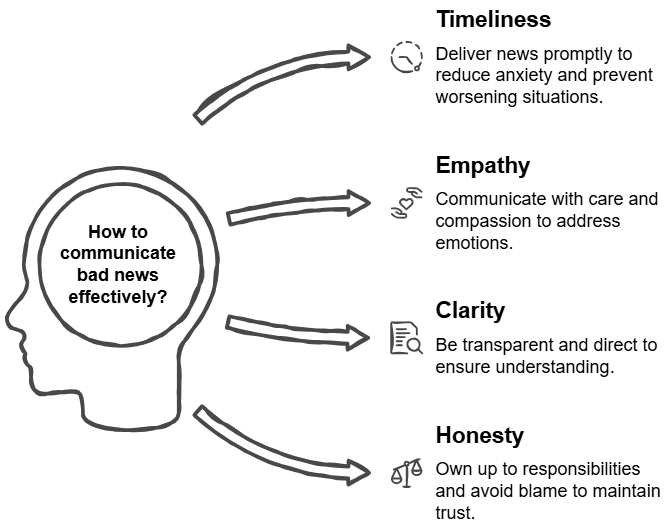
T – Timely: Avoid Avoiding
Bad news naturally triggers anxiety. Many leaders delay hard conversations because they fear the reaction, but delay often makes the impact worse.
Leah’s guidance: as soon as you can share, you should share.
Timeliness also depends on your processes. When your processes are weak, you often discover problems late, and the bad news arrives as a surprise to everyone—including you.
It reflects whether you see people as humans or just “human capital.”
For example, waiting until the day someone rolls off a project to tell them their role is ending might help short‑term performance, but it robs them of time and options. Telling them a month in advance treats them with dignity and gives them space to plan.
E – Empathetic: Put Yourself in Their Shoes
Empathy is actively considering how the other person will feel when they hear the news. You can assume they will experience some mix of fear, anger, sadness, or uncertainty. Being professional does not mean being cold; you can be caring without turning the conversation into a “kumbaya session.”
Empathy shows up in:
-
The tone of your voice.
-
The words you choose.
-
Your body language and facial expressions.
These cues tell people whether you recognize the weight of what you are saying and whether you care about their experience.
C – Clear: Don’t Dance Around the Point
In trying to be kind—or to avoid discomfort—leaders sometimes talk around the bad news so much that the person leaves without understanding what actually happened.
Leah jokes about reviews where someone spends ten minutes praising a person and never clearly says, “You are losing your job,” leaving the individual thinking it was a great meeting.
Clarity means:
-
Stating the core message directly (what is happening and when).
-
Providing as much transparency as you reasonably can about the reasons.
-
Allowing time for questions, knowing people may miss details while they process the initial shock.
Clear communication respects the other person’s need to understand not only the “what” but also the “why.”
H – Honest: Own Your Part and Avoid Blame
Honesty goes beyond not lying.
Leah calls out two common pitfalls when delivering bad news: lack of accountability and finger‑pointing. It is tempting to talk as if the problem “just happened” to the project, or to shift blame to someone else—another team, another leader, a nameless process.
Instead, effective leaders:
-
Own the parts of the situation that were within their control.
-
Avoid gossiping about or attacking others, even if others contributed to the problem.
-
Do not hide important details or invent stories to fill gaps. If you don’t know something or can’t share it, say so plainly.
Honesty builds or rebuilds trust; omission, spin, and invented explanations quickly destroy it.
Practicing Difficult Conversations and Rebuilding Trust
Hard conversations rarely go well if you “wing it.”
We encourage leaders to practice before delivering especially tough news—say the words out loud, notice what sounds awkward or unclear, and refine your phrasing until it feels both honest and kind.
Hearing yourself once or twice can reduce stumbling and make the actual conversation smoother.
Managing your own anxiety matters. Simple physical actions—like briefly moving, stretching, or “wiggling and dancing” in private—can help discharge nervous energy before a conversation so you are less likely to go into fight‑or‑flight mode.
After the News: Trust, Solutions, and Follow‑Through
Bad news often strains trust, but it doesn’t have to destroy it. Leaders can start rebuilding trust during and after the conversation by:
-
Acknowledging that the news is truly bad, not acting as if it’s routine or trivial.
-
Thinking in terms of solutions and options, even if you cannot “fix” the situation—offering alternative projects, next steps, or support where you realistically can.
-
Listening carefully to what the other person needs to see or hear to regain confidence in you or the organization.
-
Following up with updates, especially when the issue is severe. The worse the situation, the more frequently people need to hear from you, not just once and then silence.

Project managers need to communicate not only with those directly impacted (e.g., people being laid off or moved) but also with the rest of the team.
If remaining team members only hear the news through rumors, they may assume they are next and quietly start looking for other jobs. Clear follow‑up helps stabilize the broader group.
Bringing TECH into Everyday Project Leadership
For project managers and leaders, bad news is not a sign of failure; it is a normal part of navigating change. What distinguishes strong leaders is not whether they can avoid hard conversations, but whether they handle them with courage, clarity, and compassion.


Project Management Symposium
Like this presentation?
You should join us at this year’s Project Management Symposium.
Visit our Website HERE to learn more!

Project Management Programs
Are you looking to expand your project management skills?
With more than 50 courses and 17 professional certifications, our programs are built by industry experts and UMD faculty to address real-world challenges in today’s workplaces.

Some of our most popular certifications include:
-
- Agile Project Management – Navigate complex projects with adaptive frameworks.
- Construction Management – Strengthen your management expertise in construction projects.
- Artificial Intelligence in Government Procurement – Unlock the power of artificial intelligence to revolutionize government procurement.
- Project Management Professional (PMP) Exam Prep Training – Prepare for the PMP exam with confidence.

Posted by mfriday on February 9, 2026
