
 Data Analytics for the Project Manager
Re-imagining project management means confronting our history, choosing our destiny, and deciding whether we will shape the future of the discipline—or let technology and others shape it for us.


Three Quotes to Frame Project Management’s Destiny
We start by looking at project management from both the inside (years in industry) and the outside (consulting and teaching).
This helps us see patterns without being locked into one viewpoint.
The conversation is framed around three quotes:
- “If you ignore history, you’re condemned to repeat it,”
- “Don’t let your history interfere with your destiny,”
- “If you don’t control your destiny, someone else will.”
These three ideas become the buckets for everything that follows: our history, the need to evolve, and the need to actively shape where the profession is going.
A Strong History—But a Tough Scorecard
Project management has a solid formal history going back to the mid‑20th century.
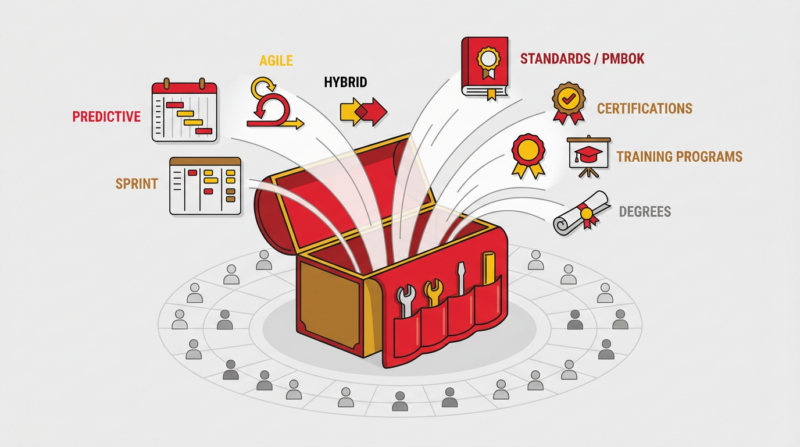
Over time we’ve built a broad toolkit: predictive, agile, hybrid, multiple standards (such as successive editions of the PMBOK), widespread certifications, training programs, and degrees, supported by a very large practitioner base.
Yet, our scorecard is sobering: failure and dysfunction rates have stayed stubbornly high for about 20 years.
Roughly 30–40% of projects succeeding and around 70% struggling or failing.
How the Profession Is Viewed
Despite growing demand for project managers, the discipline is not seen as mature in the same way as finance or marketing.
Project management is often perceived as a “craft” discipline that reassembles knowledge from other fields like communications and quality rather than standing as a core business function.
Why We Must Reimagine Project Management
Given the stubbornly low success rates and the massive investment in projects, doing more of the same is not an option if we expect different results.

Reimagined project management should actually:
- Improve outcomes
- Elevate PM as a mature, high‑ROI discipline
- Enhance project managers’ careers and progression.
It must also maintain relevance in the face of AI, which is projected to take over a large portion of project management tasks in the coming years, even if specific forecasts turn out to be off.
Limitations in the Current Practice
Several limitations in today’s project management practice shape our destiny.
Soft factors and soft skills are acknowledged as important but are not well understood, measured, or modeled in a systematic way.
Feedback loops for improving project outcomes are weak: we know failure rates are high, but we often lack structured mechanisms to learn and adjust at the organizational level.

Project management also tends to be poorly integrated with the broader work of the organization.
Project managers frequently feel they carry responsibility without authority and are heavily influenced by organizational factors they don’t control.
The Wider Workplace Context
Beyond project mechanics, the overall state of the workplace has a major impact on project outcomes.
Studies show many variables influence work success, especially in complex environments like software, and those factors extend beyond classic PM concerns.
At the same time, engagement levels are low—only a minority of employees are actively engaged, and many are burned out.
Executives and managers also experience high levels of stress and burnout, often without clear support, and recent reports suggest engagement has dropped even further, with managers feeling especially squeezed between their teams and senior leadership.
Projects in Troubled Waters
Taken together, projects often resemble ships navigating very rough seas, buffeted by organizational culture, engagement challenges, and external pressures.

It’s easy to feel that project managers can’t influence those conditions and must simply cope.
However, history shows that organizations can expand their scope to gain more control: for example, IBM moved beyond selling products into providing solutions and consulting, which in turn influenced product adoption and created new value.
The question becomes whether project management can take a similar step—moving beyond the narrow “project zone” to influence the broader work environment.
Reducing Complexity: The RESULT Model
To address the many factors affecting projects, we can use a form of “dimensionality reduction,” focusing on a few key drivers that summarize much of the complexity, similar to how blood pressure, cholesterol, and glucose provide a useful picture of health.
One such approach is the RESULT model, which assesses six dimensions:
-
Resolve (organizational will to do project management)
-
Environment (infrastructure, decision-making, mission/vision alignment, etc.)
-
Signature (project characteristics such as size and complexity)
-
U – (YOU) (individual motivation and engagement)
-
Learning (how the organization learns and improves)
-
Team (team dynamics and capability)

Each dimension can be rated on a scale and weighted by importance, producing a simple profile of how supportive—or obstructive—the context is for a given project.
What the Crowd Already Knows
When projects are rated using RESULT, something striking happens: different groups, including people who weren’t on the project and even those with modest PM experience, tend to produce very similar scores for the same project.

This suggests that people in and around the organization have a strong intuitive sense of which projects are likely to succeed or struggle.
If that collective sense could be captured and heard early and systematically, leaders could see where environment, learning, or other factors need to change to improve the odds of success.
Using AI to Predict and Improve Outcomes
Building on RESULT, it’s possible to feed those six scores into a simple neural network to predict project performance—such as whether a project will be on schedule, a bit late, or significantly delayed.
In experiments, this kind of model can successfully predict outcomes based on the RESULT profile, even if we don’t fully understand why the model works internally.
The next step is explainability: understanding which factors drive the prediction, then using that insight to guide targeted interventions in culture, decision-making, or support.
A Feedback Loop for Organizational Learning
If organizations adopt this type of model, they can create a feedback loop: assess projects at the outset, predict their likelihood of success, act on weak dimensions (for example, improving environment or learning), and then compare predicted and actual outcomes.
Over time, this loop can refine both the model and the organization’s practices, helping leaders see which changes actually improve success rates.
In this future, project managers become key interpreters of data, advising executives on how to adjust conditions to support better project and work outcomes.
A New Role: PMs as Work “Solutionists”
In this envisioned evolution, the distinction between project management and data science blurs.
Project managers operate at a higher level, using models and data to propose work solutions that align with strategy and mission, not just to manage scope, schedule, and budget.

Rather than AI replacing project managers, technology becomes a partner that analyzes patterns and projections, while humans stay “at the helm” making judgment calls and shaping organizational change.
Project managers become solutionists for how work gets done, similar to how IBM repositioned itself from product seller to solutions provider.
Alternative Paths: AI at the Helm or No Change
There are at least three possible trajectories.
In one, AI agents increasingly handle planning, execution, and monitoring, pushing humans into a secondary “assistant to technology” role and likely reducing demand for project managers.
In another, organizations adopt a RESULT‑like model and use AI as an analytic assistant while project managers steer decisions and solutions.
In the third, nothing fundamentally changes: project management continues largely as it is, with some incremental use of tools and AI but no real shift in role or outcomes, leaving success rates stuck.
Forces Driving the Future
Big shifts in technology and work are steering where project management goes next.
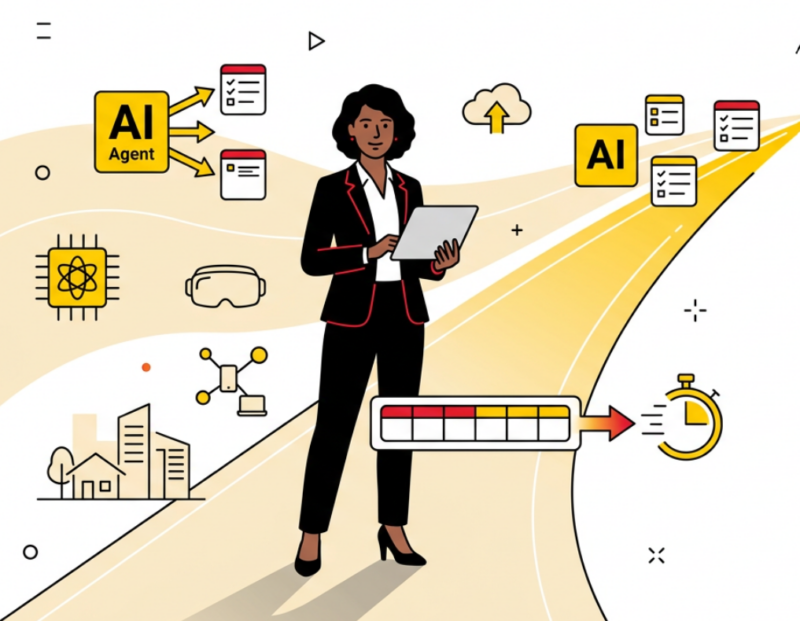
AI is advancing quickly—from automation to agentic AI—alongside changes like quantum computing, virtual reality, connected devices, and more remote work.
Agentic AI tools are already turning tasks that once took weeks into work that’s done in minutes and reshaping entire workflows.
Likely Timelines and Human Inertia
In the near term, many organizations are likely to follow a “do little” path, using some AI tools but avoiding major disruption, partly because people naturally resist technologies that might threaten their roles.
Over the next several years, agentic AI may increasingly take over routine project tasks in some organizations, especially early adopters with resources to experiment.
Over a longer horizon, it’s plausible that data‑driven, solution‑oriented project management—where PMs work hand‑in‑hand with AI models to shape work and outcomes—becomes the norm.
Choosing Our Destiny as Project Managers
Ultimately, project management’s destiny is not fixed.
We can allow AI and external forces to dictate our future, or we can reimagine our role by embracing data, modeling, and feedback loops that connect projects to the broader health of the organization.
That means remembering our history without being trapped by it, consciously choosing how we will work with AI, and stepping up to influence the conditions that shape project success.
If we take that path, project managers won’t be replaced; we’ll be leading the effort to make work itself more effective, humane, and aligned with strategy.


Project Management Symposium
Like this presentation?
You should join us at this year’s Project Management Symposium.
Visit our Website HERE to learn more!
Project Management Programs
Are you looking to expand your project management skills?
With more than 50 courses and 17 professional certifications, our programs are built by industry experts and UMD faculty to address real-world challenges in today’s workplaces.

Some of our most popular certifications include:
-
- Agile Project Management – Navigate complex projects with adaptive frameworks.
- Construction Management – Strengthen your management expertise in construction projects.
- Artificial Intelligence in Government Procurement – Unlock the power of artificial intelligence to revolutionize government procurement.
- Project Management Professional (PMP) Exam Prep Training – Prepare for the PMP exam with confidence.

Posted by mfriday on March 10, 2026
